
Part 8: The Practical Guide: When Do I Actually Start?

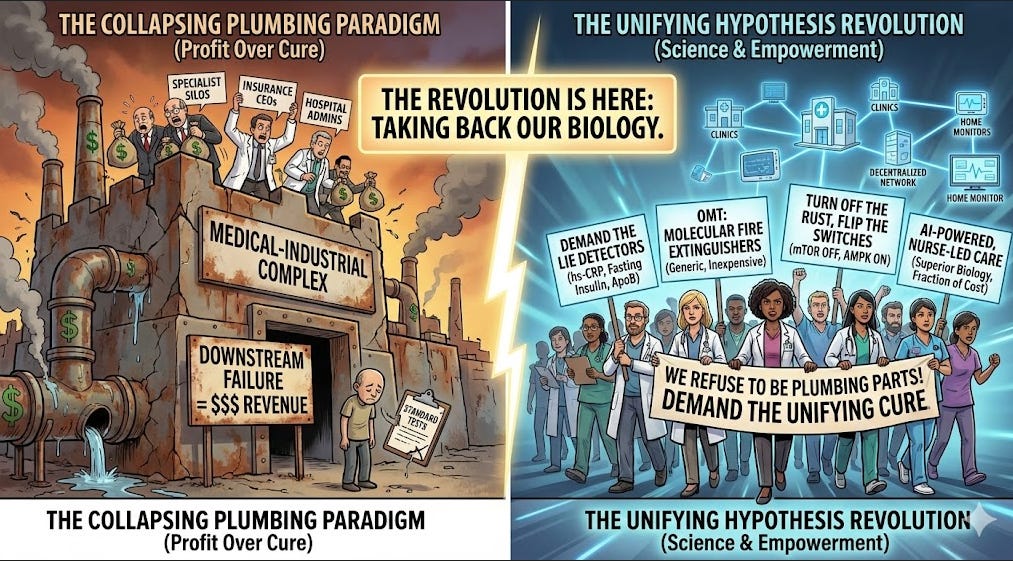
Over the last seven parts of this Unifying Hypothesis of Chronic Disease, we have completely dismantled the old plumbing paradigm of medicine. We have proven that chronic disease is a systemic biological fire driven by overwhelmed mitochondria, oxidative stress (the rust), and the inappropriate reactivation of childhood growth genes (mTOR).
We also know the solution: Optimal Medical Therapy (OMT). We must use generic, inexpensive medications to turn off the rust, activate our repair switches (AMPK), and restore the Teflon coating to our blood vessels.
But a grand biological theory is useless if you don’t know when to actually swallow the pill. The immediate question is always: “When exactly do I start taking these molecular fire extinguishers?”
The Functional Medicine Fallacy vs. True Whole-Body Science As the failures of the standard “plumbing” model have become obvious, millions of frustrated patients have fled to the alternative world of “Functional Medicine.”
To their credit, functional medicine doctors get one big thing right: they correctly view the human body as a single, interconnected ecosystem. They understand that the gut, the brain, and the joints are all talking to each other.
But their fatal flaw is their toolkit. Functional medicine attempts to treat systemic, microvascular disease using incredibly weak evidence. They blame vague “toxins” and prescribe hundreds of dollars a month in unregulated supplements, vitamins, and probiotics. You cannot extinguish a raging cellular fire with a squirt gun of herbal supplements. You cannot rebuild an oxygen-starved, ischemic gut lining by swallowing a capsule of bacteria.
Optimal Medical Therapy is the actual realization of whole-body medicine. It protects every single cell and organ in the body simultaneously, but it does so using the most rigorously tested, FDA-approved medications in human history. We are not guessing. We have absolute proof from massive clinical trials that these generic molecular fire extinguishers radically alter the course of the disease, producing outcomes that shock the medical establishment—like the UK’s National Health Service recently projecting massive reductions in heart attacks, kidney failure, and amputations by shifting their diabetes guidelines toward an OMT approach.
Threading the Medicolegal Needle Because we need these powerful, evidence-based medications, we have to navigate the reality of the current medical system. Doctors are bound by FDA drug approvals and the accepted “Standard of Care.” If you ask for a drug without a corresponding diagnosis, the system will push back.
But the beautiful thing about OMT is that we can use the establishment’s own clinical triggers to get you the exact epigenetic protection you need.
Here are the specific thresholds where the standard of care perfectly aligns with turning off your cellular rust:
The Blood Pressure Trigger (When to start an ACE inhibitor or ARB)
The Rule: If your blood pressure consistently reads over 130/80, or if you have chronic kidney disease or heart failure you should be on an ACE inhibitor or ARB.
The Biology: Standard medicine gives you this drug simply to “relax the pipes” and lower the pressure. But as we know, what you are actually doing is chemically blocking Angiotensin II. By starting at 130/80, you are turning off the master “fetal growth” switch before it can cause massive oxidative stress and destroy your micro-vessels.
2. The Metabolic Trigger (When to start Metformin)
The Rule: If you are diagnosed with Prediabetes or Type 2 Diabetes, you should be taking Metformin.
The Biology: The establishment gives you this to lower your HbA1c. But from an epigenetic standpoint, you are using it to forcefully flip your AMPK repair switch to the “ON” position. You are sending a survival signal to your cells to clear out the overwhelmed mitochondria and stop the inappropriate growth signaling.
3. The Vascular & Inflammatory Trigger (When to start a Statin)
The Rule: If you have established artery disease, diabetes, or high cholesterol, you should be on a statin.
The Biology: This is where we have to be highly precise. In broad “primary prevention” (giving a statin to a perfectly healthy person with slightly elevated LDL but no disease), statins do not show massive clinical benefits. Why? Because if there is no biological fire, you don’t need a fire extinguisher.
The Hidden Fire: However, if you have a systemic inflammatory disease—like Rheumatoid Arthritis or Psoriasis—your risk of a massive heart attack skyrockets. Standard medicine is baffled by this. But we know why: Your body is flooded with oxidative stress and toxic SASP (Zombie Cell secretions). In these patients, or in patients with a highly elevated hs-CRP, a statin acts as a potent endothelial anti-inflammatory. It isn’t just lowering small dense LDL; it is physically restoring the Teflon coating (the glycocalyx) of your blood vessels and turning off the systemic rust.
The Bottom Line: You don’t need to wait for a heart attack to fix your cellular engine. If you hit any of these standard-of-care triggers—a BP over 130/80, creeping blood sugar, or systemic inflammation—you have the medicolegal right to ask your doctor for OMT. Use their rules to protect your biology. Chronic disease and aging are related. The day is probably coming when we will use these fire extinguishers to slow both and the evidence says it will work, we just aren’t there yet. When this catches on and we have big data from following hundreds of thousands of patients on OMT, we will be able to recommend OMT at a certain age for many more people.